
No clean plate: that’s how global food waste has become a ticking bomb
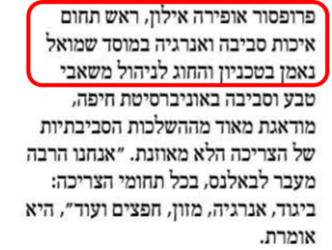
Food waste has an enormous impact on the environment, mainly due to greenhouse gases emissions. Prof. Ofira Ayalon of the University of Haifa and the Samuel Neaman Institute, a senior researcher in the fields of environmental,
sustainability and economics, realized in her research that there is great uncertainty regarding the extent of household food waste due to the different measurement methods, and together with Efrat Elimelech, in her PhD thesis, tried to conduct a waste survey among 200 families of the socio-economic strata 7-8 in Haifa. The results were published in 3 academic papers.
Brain gain it is not just the money
Manuel Trajtenberg
Several programs implemented in recent years have tried to bring back the fleeing minds to Israel. Aside from the tax relief provided by returning residents, there have also been attempts to change the budget of the universities so that young researchers can be employed.
“There is one very significant statistic: the senior faculty at universities,” says Prof. Manuel Trajtenberg of Tel Aviv University and the Samuel Neaman Institute at the Technion, who served as chair of the Planning and Budgeting Committee of the Council for Higher Education until 2014.
“In 2000-2009, there was a significant decline in senior faculty members, And since 2010 the trend is reversed and an increase in numbers has begun again. “
Career matters the kids even more
Manuel Trajtenberg
The employment rate of women in Israel is among the highest in the Western world, as is the birth rate.
These two reinforce the need for a different preparation. Prof. Manuel Trajtenberg recently published a policy document for the Samuel Neaman Institute at the Technion offering comprehensive reform in early childhood care.
Among other things, it suggests introducing more flexibility into the “first parenting” period. It is preferable that in the first half of the year parents be the ones to care for the child, but at the same time he offers to set up early childhood campuses with support services, guidance and professional guidance.
Zuckerman Fund for AI Revolution
Ella Barzani, Daphne Getz, Eran Leck, Sima Tziperfal, Avida Shoham, Roey Tzezana, Shlomo Rosenberg
The Technion is home to the greatest proportion (28 percent) of the 270 researchers in the fields of AI, data science, and smart robotics working across Israel’s universities and colleges, according to a recent report compiled by the Samuel Neaman Institute for National Policy Research at the request of the Israeli Ministry of Science’s National Council for Research and Development.
The report found that the top three interests of the Israeli researchers are machine learning, AI, autonomous systems, and smart robotics, with their other interests spanning human-computer interaction, natural language processing, computer vision, data mining, distributed systems/computing, big data, multi-agent systems, neural networks, and reinforcement learning.
Pay as you throw Will the model work in the country?
If this is indeed such an effective tool to reduce the amount of waste produced and encourage recycling, why is it not implemented in Israel? “This is an economic mechanism that works with a rationale behind it, there is a direct link between the amount that is thrown out and the payment that is being paid, but the mechanism is not flawed,” says Prof. Ofira Ayalon, Head of Environmental cluster at the Samuel Neaman Institute of the Technion and Department of Natural Resources and Environmental management at the University of Haifa. “For example, in this method recycling does not cost the resident money, so there may be a situation where people place non-recyclable products in the recycling bins in order to pay less, which damages the efficiency of the method,” adds Ayalon.
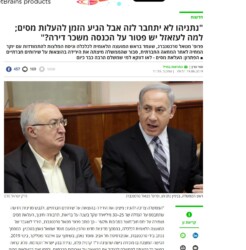
Netanyahu will not love this, but it’s time to raise taxes
Manuel Trajtenberg
The government should recognize that we have exhausted the decline in social services spending, and formulate a new policy that will strive to increase the budget for health, transportation, education, and housing by about 25 billion NIS per year, and at the same time raise taxes so as to maintain the debt-to-GDP ratio at 60%, “
writes Prof. Manuel Trajtenberg , Former chairman of the National Economic Council, in a new policy document prepared by the Samuel Neaman Institute at the Technion.
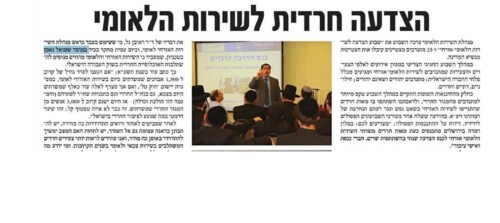
Haredi salute to National Civic Service Article in the “Hapeles” newspaper, 28.6.2019
Dr. Reuven Gal, who served in the past as head of the National Civil Service Administration and is currently a senior fellow at the Samuel Neaman Institute at the Technion, explains that the civic and national service constitute a leverage for the integration of the Haredi population into the Israeli labor market.
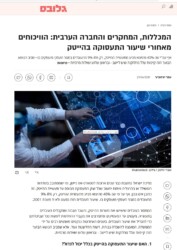
Colleges research and Arab society the arguments behind the rate of employment in high-tech
Benjamin Bental, Dan Peled
Another controversial study was published two years ago by the Samuel Neaman Institute. According to this study, there is no shortage of engineers in Israel. Their argument refuted the industry’s claims of a severe shortage of workers, which also led to a sharp increase in programmers’ wages.
According to researchers Dan Peled and Benjamin Bental, there is no gap between the number of engineers qualified each year and the need for the market.
Drowning in waste- Nashim magazine
): Unbalanced consumerism, from food to clothing, imposes an environmental burden both by over use of environmental resources and by waste production. Once we buy something, we need to remember that cheap products are environmentally expensive.
Electrifying Tel Aviv The citys dramatic plan for city transportation is revealed
Ofira Ayalon, Idan Liebes
Charging stations in parking lots, electric shared cars and the prohibition of entry of polluting vehicles
• The Tel Aviv Municipality begins to “electrify” the vehicles in the city, in a process that will last until 2025.
• The project has not yet been budgeted, and it also depends on cooperation with the government